
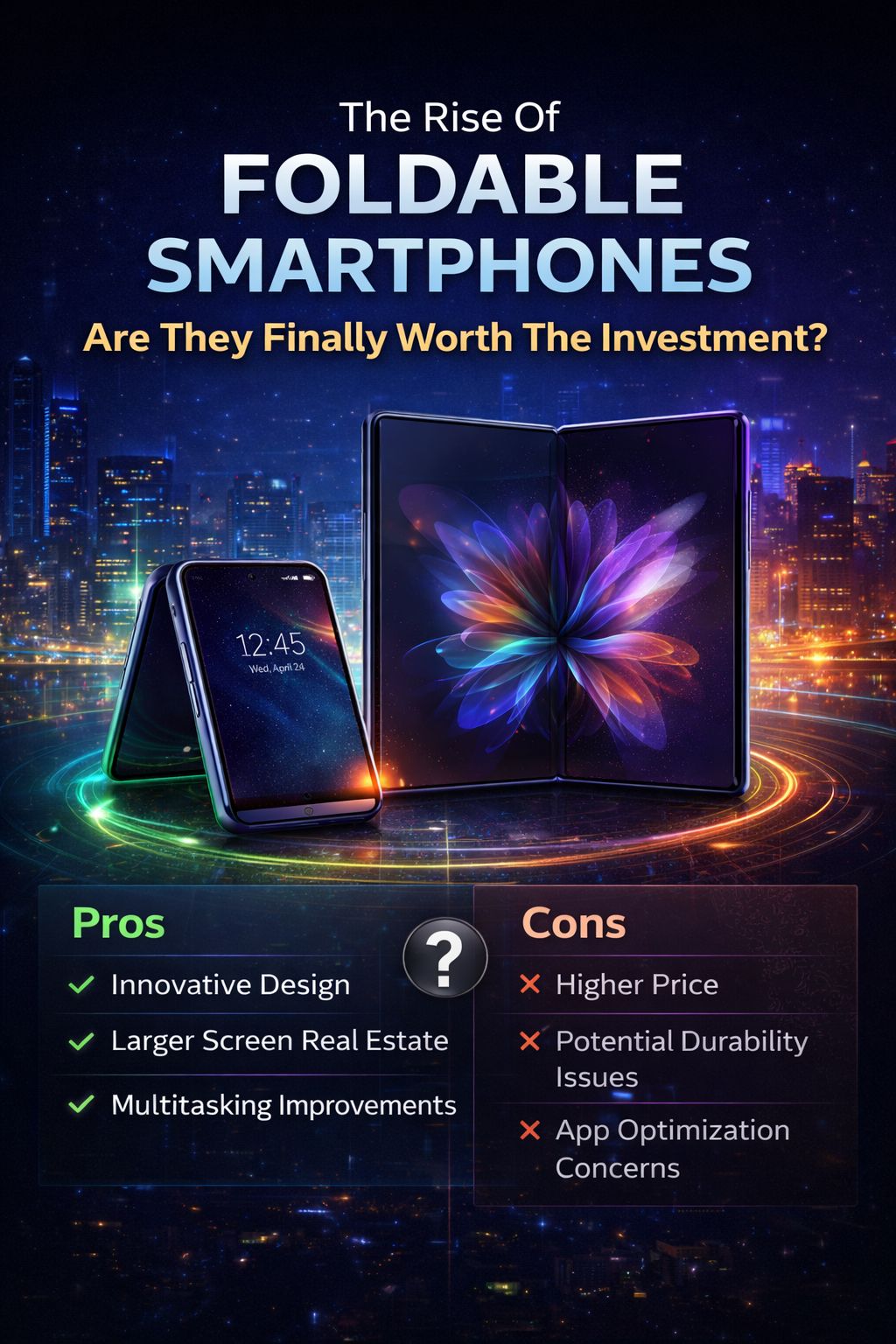
Introduction: From Gimmick to Reality
A few years ago, foldable smartphones felt like a futuristic experiment—something exciting to watch but not practical enough to buy.
Early models had issues:
- Fragile screens
- High prices
- Limited durability
Many people saw them as a “luxury gadget” rather than a daily-use phone.
But fast forward to 2026, and things have changed.
Foldable smartphones are no longer just a concept. They’ve improved in design, performance, and reliability. The question now is no longer “Do they work?” but rather:
👉 Are they finally worth your money?
Let’s break it down in a simple, honest way.
What Are Foldable Smartphones?
Foldable smartphones are devices that can physically fold, allowing them to switch between:
- A compact phone size
- A larger tablet-like screen
There are mainly two types:
1. Book-Style Foldables
These open like a book, giving you a large inner display.
👉 Best for productivity and multitasking
2. Flip-Style Foldables
These fold vertically into a smaller size.
👉 Best for portability and style
Why Foldables Are Gaining Popularity
1. Bigger Screen, Same Pocket
One of the biggest advantages is flexibility.
You can:
- Use it as a regular phone
- Open it for a bigger screen
👉 This is especially useful for:
- Watching videos
- Reading
- Gaming
- Multitasking
2. Improved Technology
Earlier foldables had issues with screen durability and hinge design.
Now:
- Screens are stronger
- Hinges are smoother
- Devices feel more solid
👉 Manufacturers have clearly learned from early mistakes.
3. Better Software Optimization
Apps now adapt better to foldable screens.
- Split-screen features
- Drag-and-drop multitasking
- Optimized layouts
👉 The experience feels more natural than before.
The Real Advantages of Foldable Phones
✔ Multitasking Like a Tablet
You can:
- Run two or three apps at once
- Reply to messages while watching videos
👉 Great for productivity
✔ Unique User Experience
Foldables offer something different.
👉 It feels new and innovative compared to regular smartphones.
✔ Compact Design (Flip Models)
Flip phones fold into smaller sizes, making them easy to carry.
👉 Perfect for people who prefer portability.
The Downsides You Should Know
Let’s be honest—foldables are not perfect yet.
❌ High Price
Foldable phones are still expensive.
👉 You’re paying for innovation.
❌ Durability Concerns
Even though improved, they are still more delicate than traditional phones.
- Folding screen
- Moving parts
👉 Requires careful handling
❌ Battery Limitations
Slim designs and dual screens can affect battery life.
👉 Not always as strong as regular flagship phones
❌ App Compatibility (Still Improving)
While better than before, not all apps are perfectly optimized.
📊 Foldable vs Regular Smartphones
| Feature | Foldable Phones | Regular Phones |
|---|---|---|
| Screen Size | Flexible | Fixed |
| Price | High | Moderate |
| Durability | Medium | High |
| Innovation | Very High | Standard |
| Battery | Moderate | Strong |
📖 Real User Perspective
A friend of mine switched from a regular smartphone to a foldable.
At first:
- Excited about the design
- Loved the big screen
After a few weeks:
- Used split-screen daily
- Watched more content comfortably
- Became more productive
But:
- Had to be careful with handling
- Noticed battery drain during heavy use
👉 Overall, the experience was positive—but not perfect.
Who Should Buy a Foldable Phone?
✔ Content Consumers
If you watch videos, read, or browse a lot
👉 Bigger screen = better experience
✔ Professionals & Multitaskers
If you use multiple apps
👉 Foldables can improve efficiency
✔ Tech Enthusiasts
If you like trying new technology
👉 Foldables are exciting
Who Should Avoid It (For Now)
❌ Budget Users
Foldables are still expensive
❌ Rough Users
If you drop your phone often
👉 Not ideal
❌ Basic Users
If you only use calls, WhatsApp, and browsing
👉 Regular phones are enough
Are Foldables Worth the Investment in 2026?
👉 The answer depends on your needs.
✔ YES, if:
- You want a bigger screen experience
- You enjoy new technology
- You can afford the price
❌ NO, if:
- You want durability above all
- You are on a tight budget
- You prefer simplicity
🚀 What’s Next for Foldables?
The future looks promising:
- Prices may decrease
- Durability will improve
- More apps will support foldables
- Designs will become thinner and lighter
👉 Foldables are moving toward becoming mainstream.
❓ FAQ Section
Q1: Are foldable phones durable in 2026?
Yes, more than before—but still less durable than regular phones.
Q2: Do foldable screens break easily?
Not easily, but they require careful use.
Q3: Are foldables good for gaming?
Yes, especially for larger screen experience.
Q4: How long do foldable phones last?
With proper care, similar to regular smartphones.
Q5: Will foldables become cheaper?
Most likely, as technology improves